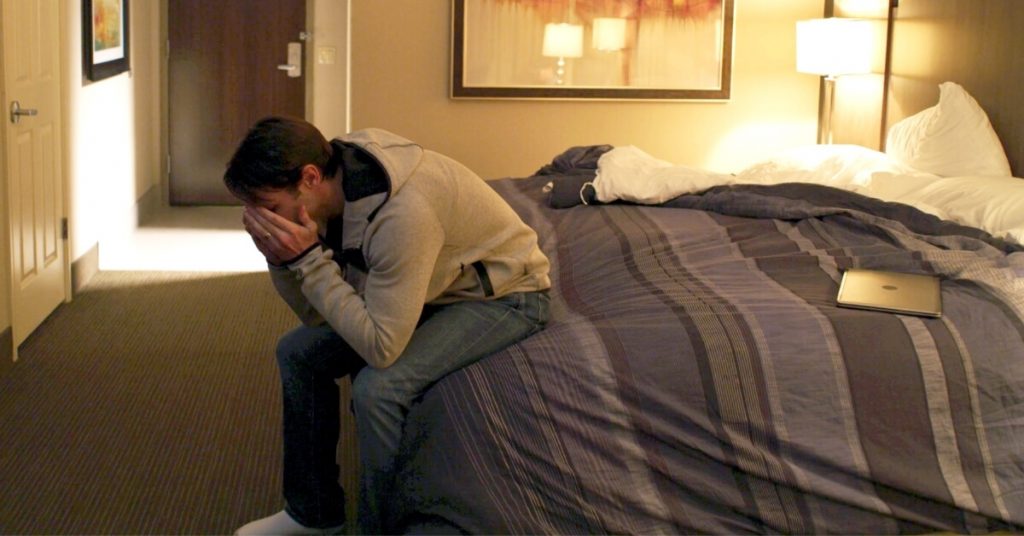
3 Reasons It’s Not Okay to Use Porn to Spice Things Up in the Bedroom

I remember when my wife was 8 weeks pregnant and she was reading in a few online discussion forums for pregnant women. She came across a number of threads of conversation about pornography. Several women said their husbands had really ramped up their use of porn during the pregnancy. To some women this was deplorable. To other women this was seen as all right (“After all, don’t all guys look at porn?”).

One common theme I noticed among the more permissive women was that the only ethical dilemma was related to a guy “sneaking around” to look at porn. For these women, the real problem with porn is the secrecy that often comes with it. They believe as long as he’s open about it, there’s no problem. If they watch it together in the bedroom, no harm done.

I think wives who allow this to go on in the bedroom need to stop and think about the consequences.

1. First, I would challenge wives to think about what their standards are for a healthy sexual relationship. Is it merely bigger orgasms, more experimentation, more variety, or is there something of a connection you long for? Could sex actually be better if you knew you had all of your man, not just his body, but his full attention?

Where is your husband’s mind during love-making? Is it more focused on the women in the porn flick, or you? Even when he’s not looking at the screen, where is his mind? Mentally, what he is doing is similar to watching porn while alone and masturbating, only in the bedroom he’s using his your body.

I agree with Dr. Judith Reisman when she says porn causes men to be impotent, in the classic sense of the word: unable to function with their own sexual power.

If he can’t make love to his beloved, if he has to imagine a picture, if he has to imagine a scene, in order to actually reach the heights of completion with this person, then he’s no longer with his own power, is he? He has been stripped. He has been hijacked. He has been emasculated. He has, in effect, been castrated visually.

I believe if wives are being honest with themselves they would say, “No, I do not want to train my husband’s mind to always need to withdraw into fantasy in order to orgasm. I want to know he is fully present with me.”

2. I would challenge wives to think about all the psychological harms that come with repeatedly watching pornography in general. Viewing pornography has been proven, for both men and women, to decrease our sexual satisfaction in marriage, make us escape into fantasy and avoid connection in authentic relationships, lower our view of women, and create a thirst for watching more pornography. (I outline a lot of these harms in a short e-book I wrote called Your Brain on Porn.)

Bringing porn into the bedroom exposes a husband to these harms. A wife should fight for the sexual health of her man. Bringing porn into the bedroom also exposes you as a woman to these harms (as this great testimony on our blog talks about).

3. I would remind you that God is the wise designer of sex, and godly sex, as He commands it, should not contain elements of lust. Certainly some women might believe their man isn’t lusting after the women in pornography if they’re using it to spice up their bedroom life, but this is turning a blind eye to how they know their man really is. If he were alone masturbating to porn, he would be lusting. If he’s in the bedroom with you being turned on by the women he sees on the screen and filling his mind with images of them, then he’s lusting. Yes, he may simultaneously be turned on by you. But this is like eating a salad and washing it down with a BK Whopper and saying you had a healthy meal.

Porn Capital of America Under Fire: Will the condom legislation force porn out of California?

After much work on the part of the Pink Cross Foundation, the California Occupational Safety and Health Administration (Cal/OSHA), and the AIDS Healthcare Foundation, the nation’s largest hub of commercial pornography may be shutting down. Right now the San Fernando Valley (called “San Pornando Valley” by some) is the home to companies that produce 90% of the nation’s porn supply. But a 9-1 vote from the LA city council on January 17 might be changing that.

The porn industry may be required to have all their performers use condoms.

Enforcing this law puts porn producers between a rock and hard place. The rock would be their blatant violation of workplace health laws. The hard place would be the demands from porn consumers: no one, apparently, wants to see condoms in their porn films.

Recently I asked Shelley Lubben, founder of the Pink Cross and a former porn actress, what this vote could means for the porn industry. Read More…

Are we getting better about guarding children from pornography?

Unwanted access to porn may be on the decline

According to the Journal of Adolescent Health, unwanted exposure to pornography is less common today. Over the last 10 years there have been three Youth Internet Safety Surveys (YISS) conducted (in 2000, 2005, and 2010). In these surveys children and teens, ages 10 to 17, were asked, “In the past year  when you were doing an online search or surfing the web, did you ever find yourself in a Web site that showed pictures of naked people or of people having sex when you did not want to be in that kind of site?”

Here were some of the results:

  • Between 2000 and 2005 there was an increase in unwanted exposures to porn, going from 25% of youth to 34% of youth.
  • Between 2005 and 2010 there was a decrease in unwanted exposures to porn, going from 34% to 23%.
  • In each YISS survey, unwanted exposures to porn were more common among the 16-17 age group. In 2010, 28% of 16-17-year-olds said they had unwanted exposures.
  • For the 10-12 age group, unwanted exposures to porn have increased overall in the last 10 years: from 9% in 2000 to 15% in 2010. (There was a spike of 19% in 2005.)

The authors of the study attribute the overall decline to two factors:

  1. The detection capabilities of spamware and filters have become more refined in the last 10 years.
  2. Young people may have become better educated and more savvy about opening unidentified e-mails or clicking on unidentified links.

For those in the Internet safety sphere, this report is cause for celebration. Technology and education may, in fact, be paying off. However, we must also pause and remember these stats only apply to “unwanted” exposures to pornography, not youth who are intentionally accessing or looking for porn.

Read more:

  1. Teens and Porn: 10 Stats You Need to Know
  2. The Unfiltered Truth: Children Search for Pornography From an Early Age, by Brittany Glynn
  3. Tips for talking to your kids about porn: Important issues for important ages, by David Wever, LMFT
  4. Internet Precautions: Tips for helping you and your kids make good choices online, by Emily Malone

Free E-Book:

Learn more about Internet dangers in our new guide, Parenting the Internet Generation: 7 Potential Threats and 7 Habits for Internet Safety. In this guide you will learn not only about pornography, but other online dangers for kids and teens. You will also learn proactive steps you can take to protect your children and your home.

“Not Even a Hint” of Sexual Immorality? Sobering Words to Those Who Like Porn

“But among you there must not be even a hint of sexual immorality, or of any kind of impurity, or of greed, because these are improper for God’s holy people.” – Ephesians 5:3

I was awakened to this verse when I read Every Man’s Battle by Fred Stoeker and Stephen Arterburn, an essential book for any of us seeking to be sexually pure. Ephesians 5:3 is the theme verse for Every Man’s Battle, and it’s become the theme verse for my own sexual purity journey. It sums up my personal purity mission.

“No hint of sexual immorality” is the big goal we need to have in our sexual purity journeys. There are other sins and worldly pursuits mentioned in this passage but sexual immorality stands out the most for me.

If you read Ephesians 5 you’ll see that Paul calls the us to be above the world (v.1). Don’t be like the world. Don’t imitate the people in the world and their ways. Instead, imitate God.

Let’s look at the phrase “not even a hint.” I wish that it didn’t say it like this. I would like to allow a “hint” of sexual immorality every once in a while. Do you ever feel like that?

I may allow for it in my standards, but there’s no place for it in God’s standards. My standards are sub-par and usually have to do with stopping behaviors I don’t like anymore. But God has something different for me, something deeper. He wants me to be pure. Period. Completely pure. No hint of sexual immorality.

God broadens his call to purity when he adds “or of any kind of impurity.” There are impurities I allow into my life that are not necessarily sexual. God is trying to tell me “don’t be stained by the world.” He pounds this truth again when he reminds me I’m one of “God’s holy people.”

As I’ve wrestled with this verse in my sexual purity journey, I’ve had a couple of sincere questions to God.

Question #1: Is this really possible?

I think the answer is “no,” not with us…not when it comes to having no hint of sexual immorality or impurity. It has to come from God. He leads us in this direction and will provide for us.

I think the problem I have (and many of us have) is that I really don’t believe this Scripture. I know it in my mind, but I don’t believe it in my heart. I don’t think it’s achievable. I think there must be some other understanding of this verse.

Just because I haven’t had sustained victory in an area like masturbation, adultery, or lustful thoughts doesn’t mean that it’s not God’s standard. Also, it doesn’t mean that it can’t be done. There must be a faith component to this verse. I know that nothing’s impossible for God, but my heart is not always there yet.

Early in my recovery, I wished that sexual purity would come my way instantly. I wanted magic. I wanted to go from struggling to having no struggles. I wanted my sexual problems to disappear immediately. I kept looking for God to wave His magic wand over me and it would be easy. It never worked out that way.

This verse reminds me how much I need God for my sexual purity journey, and how impossible it is for me.

Question #2:  Why would God impose this on me?

I felt like God was being cruel by asking this of me. I believed I needed sex and sexual stimulation in order to be okay and have my needs met. I thought I needed to have an orgasm to be fulfilled and take the edge off. I thought sexual satisfaction was a part of being a man.

When I got honest with God, I would pout, “Why can’t I have just a little bit of sexual stimulation? Don’t you know that I need it? Don’t you know that I can’t live without sex?”

This was one of the many lies I believed about sex. My heart was deceived. I convinced myself that having sex and having orgasms were basic needs for any man.

I was angry that God was calling me to a higher standard. I didn’t like it. I liked my standard. I liked what I was already doing. I liked my “drug of choice.” I liked to be able to masturbate, look at Internet pornography and objectify women.

The Path Toward Healthy Sexuality

Until my recovery began, I didn’t realize I had never experienced healthy sexuality. I thought I was healthy when I would stop looking at porn or stop masturbating. But health was more than sobriety and stopping bad behaviors.

Ephesians 5:3 calls me to trust God with my sexuality and surrender it to Him. It becomes a matter of faith. Do I believe God’s Word is true? Do I believe that His standard is the best? Am I willing to obey and adopt His standard as my own?

Key Purity Principles

  1. God calls us to the highest standard of sexual purity.
  2. Sexual purity is impossible without God’s power. The desire to be pure pushes us toward God.
  3. Sexual purity goes against the flow. We’re not going to be like the world and like our buddies any more.  It’s all about being holy people and imitators of God.

. . .

Jeff Fisher is a blogger, podcaster, and minister. He and his wife Marsha live in Raleigh, NC with their two children Caleb and Noah. They run the website PornToPurity.com, a site designed to offer hope, encouragement, and resources to individuals and couples struggling with sexual sin. His Top Tips For Sexual Purity Podcast is also available on iTunes.

Is YouTube for Kids? Concern About Porn and Other Sexual Content on YouTube

YouTube: it’s the world’s largest video sharing website. A remarkable 48 hours of video are uploaded to YouTube every minute—that’s about 8-years of content uploaded every day. This content is initially unmonitored.

YouTube does have “Community Guidelines” which specifically state: “YouTube is not for pornography or sexually explicit content.” With so many videos being posted, how do they enforce these Guidelines?

Flagging Videos

YouTube users themselves are the first line of defense against inappropriate videos. YouTube.com has enabled users to “flag” videos they deem inappropriate. When you click the “flag” icon, you have the opportunity to indicate why you think the video violates the Community Guidelines.

After you flag a video, YouTube staff review it to see if it fails to conform to the Guidelines. As far as sexual content goes, YouTube stresses,

Most nudity is not allowed, particularly if it is in a sexual context. Generally if a video is intended to be sexually provocative, it is less likely to be acceptable for YouTube. There are exceptions for some educational, documentary, scientific, and artistic content, but only if that is the sole purpose of the video and it is not gratuitously graphic. For example, a documentary on breast cancer would be appropriate, but posting clips out of context from the documentary might not be.

Porn on YouTube

That being said, there are still thousands of provocative videos on YouTube. Some never get flagged. Others, even when flagged, do not technically break the Community Guidelines, so they are allowed to remain on YouTube.

In 2009 the Media Research Center (MRC) examined the volume of softcore pornography on YouTube. They looked at the most popular search results for the word “porn.”

  • Searching the word “porn” returned more than 330,000 results, many of which were sexually suggestive in their language and themes.
  • There were 157 videos with more than one million views each found under this search. Two-thirds of these advertised themselves as being actual pornography.
  • Many videos featured clips from actual porn movies, interviews with porn stars, advertisements for porn sites, and phone sex lines.
  • Profanity was also commonplace in the titles and comments for the videos.

Protect Your Kids Online

Learn more Internet dangers, like pornography, in our new guide, Parenting the Internet Generation: 7 Potential Threats and 7 Habits for Internet Safety. In this guide you will learn not only about pornography, but other online dangers for kids and teens. You will also learn proactive steps you can take to protect your children and your home.

Should I Fire My Accountability Partner?

“He’s so useless, if he had a third hand he would need a third pocket to put it in.”

This is how some Covenant Eyes members feel about their Accountability Partners. As I glance through e-mails and comments from our members, it is clear some don’t feel their Partner is really up to the task.

What do you want from your Accountability Partner?

Of course, some people don’t want a super-vigilant Accountability Partner. Earlier last year I sent out a survey to our blog readers about why they value having the Covenant Eyes Accountability program on their computers and cell phones. I asked our users to give a number rating on a scale of 1 to 10:

  • 1 = “I rarely or never have conversations with my Accountability Partner(s) about my Accountability Report. I just like knowing I’m being watched.”
  • 10 = “I have regular conversations with my Accountability Partner(s), and we often talk about my Accountability Report, even when the report looks good.”

I was surprised by the results. Over half (53%) of the people said 1, 2, or 3. Only 20% said 7, 8, 9, or 10.

It seems, even for our regular readers, the thing many of them value about Internet Accountability is just the knowledge that someone is watching them. They aren’t necessarily looking for a proactive Partner to help keep them in line.

Still there are others who want more. In a recent comment, “Tim” said there are three reasons why his Accountability Partner is falling short:

  1. His Partner does not show due diligence: he doesn’t read each Report and offer some specific comments on each one.
  2. His Partner is not timely: he doesn’t offer feedback until he has multiple Reports and is playing catch-up.
  3. His Partner is not alert to the whole Report: he doesn’t look at the “grey areas” on the Report—not just the Highly Mature sites but others that could be problematic.

Setting Expectations: 7 Tips

Before you fire you Accountability Partner, you may need to have a talk about expectations.

Whether you are disenchanted with your current Accountability Partner or are looking for one for the first time, it is important to set mutual expectations. I suggest using the Covenant Eyes Rating System and the modules on the Accountability Report to do this:

  1. Tell your Partner to how often you think they should get the Accountability Report. They can get your Reports delivered to them once every three days, once a week, or once every two weeks. Tell them which frequency you think is best based on your Internet surfing habits. Your Accountability Partner can change this Report setting on our website.
  2. Tell your Partner which sensitivity level is best for your Accountability Reports. Your Partner can choose a Report Sensitivity Level, giving them a choice about what web ratings they want to see on each Report. Are you only concerned about visiting porn sites? Then the HM (Highly Mature) setting is probably right for your Reports. Are you also concerned about other sites that might provoke lust (lingerie sites, crude humor, video sharing sites, dating sites, etc.)? Then the M (Mature) or MT (Mature Teen) settings might be better. Your Partner can also change this setting on our website.
  3. Tell your Partner to pay close attention to sites with high ratings. Your Partner can get a glance of some of the highest ratings by going to the “High Ratings per Site” module on the Accountability Report. Often page titles will appear, which should give your Partner a better idea about a questionable site. If page titles don’t appear, have your Partner look for questionable words in the web address, if there are any. Your Partner can learn more about how to read the Report here.
  4. Tell your Partner what times of day or night he/she should look out for. If you don’t think you should be online at 1:00 a.m., tell your Partner that. Each time a website is accessed, the time it was accessed will also appear on the Accountability Report. To get a general overview of this, tell you Partner to go to the “Average Hourly Usage” module on the Report. They’ll see a graph showing the times of day in percentages when the Internet was accessed.
  5. Tell your Partner about any “grey areas” he/she should be looking out for. You know where you get into the most trouble. Is it Facebook? Chat sites? Photo sharing? YouTube? Talk to your Partner about those sites and make sure they keep an eye out for them on the Report.
  6. Tell your Partner to ask you about any questionable web searches. On every Report you can choose to see the “Web Searches” module which gives a list of all the highly rated searches you did. Tell your Partner to always pay close attention to this section and ask you specifically about any questionable search.
  7. Tell your Partner how often and under what circumstances you expect them to talk to you about your Report. Do you want to hear from your Partner right after he/she sees the Report? Tell them that. Do you only want them to talk to you after a questionable Report, or even when the Report looks good? Tell them that. When they contact you, do you prefer they drop you an e-mail, call you, or talk to you in person? Tell them that. Setting these expectation will really help them do their job better.

Christian Teens and Pornography: How big is the problem?

Just how widespread is the problem of youth in the church watching pornography today?

Our friends Josh and Jeannie Yates who work in youth ministry at Gingellville Community Church were interviewed about their experience regarding young people and pornography. They also talk at length about why they use Internet accountability software and why they even “prescribe” it to the teens they work with.

This interview is from the creators of Willful Entrapment, an expressive short film about the cost of porn addiction. Make comments about this video on ScratchingTheSurfaceDoc.com. Read More…

You just caught your child looking at porn. What do you do?

My friend Luke Gilkerson with Covenant Eyes interviewed me regarding how to respond to a parent who just caught his/her son in porn.

Luke’s questions are in italics, with my responses underneath:

Start with hope

LG: Let’s say a dad came to see you for advice about his teenage son. He tells you his son has been sneaking out of bed late at night looking at porn on the computer. He’s put filters in place but his son seems to be able to get around them. How might you start advising this father?

The first thing the parent needs to know is that God’s grace is sufficient for this.

The starting point when dealing with personal challenges must be in the hope we have in God. While we may not be able to understand everything that is going on in our lives, we can understand, know, and trust in God’s goodness even in our darkest hours.

I would want to make sure the parents are rooting their hearts and minds in God alone. God is writing His story in their lives. God is in control. God is working His plan.

And most importantly they need to know that God is good. These should be fixed anchor points in their hearts. My first goal would be to make sure the parents are rooted in these truths.

The second thing I would want to do is make sure the parents understand that the real issue is in the kid’s heart, not on his computer. While the parent can use technology to guard the computer, he will need to take another approach to guard the child’s heart.

But each person is tempted when he is lured and enticed by his own desire. Then desire when it has conceived gives birth to sin, and sin when it is fully grown brings forth death. – James 1:14-15 (ESV)

Sometimes a dad or a mom can have a hard time accepting what they are seeing in their children. While they can understand why other children mess up, it can be hard to receive and accept the truth about their own children.

If a child, like the one you’re asking about, goes to these lengths to get to porn, then you are more than likely talking about what our culture calls an addiction. Paul frames it better by calling it being “caught” in a transgression.

Brothers, if anyone is caught in any transgression, you who are spiritual should restore him in a spirit of gentleness. Keep watch on yourself, lest you too be tempted. – Galatians 6:1 (ESV)

It may be helpful for them to reframe what is happening in their family another way. For example, if you think about an alcoholic or crack addict who was circumventing sound advice and obstacles to drink or use, then it may be easier for the parent to see the depth and severity of the problem.

This kid is not a victim to his culture or to technology. He is premeditating how he can get to porn. He is a user. According to James, porn is in his heart. He is being lured away by evil desires that he fosters in his heart. Read More…

Is the iPad the Real American Idol?

I gave my wife Priscilla an iPad for Christmas this year and life will never be quite the same in the Lohrmann household. Yes, she’s owned (and regularly used) desktops, laptops, cellphones and more over the past decade, but this is different—very different. Allow me to explain.

After plenty of research, we decided to buy the iPad 2 WiFi + 3G version, so she could use it easily on the road. Now, she always has it with her. Whether playing music, reading the Bible (at home or in church), visiting friends, driving my daughter back to college (from central Michigan to Chicago), writing her grocery list or looking for a dinner recipe, she’s discovered the meaning of the popular phrase: “There’s an app for that.”

To say that she really likes her iPad would be a vast understatement—like saying Mount Everest in a tall hill.

At work, a similar transformation is occurring. Since the early days of working with (Michigan) Governor Synder’s transition team in 2010, it was clear that iPads were more than a cool new fad, they were the “new normal” in government. Over the past year, I’ve seen the same trend nationwide with businesses, university students, and more jumping on the bandwagon. In fact, the explosion of tablet PCs (including the Kindle Fire and Droid-enabled versions) is starting to create that paperless office we’ve been talking about for decades—with e-books and helpful applications for just about every possible activity.

Meanwhile, the content being offered to us is changing as well. New applications, websites, videos, music and attractive services from Google, Facebook, Twitter and new startup companies continue to raise expectations and possibilities. The dream of any data on any device at anytime from anywhere is slowly becoming a reality. Read More…

Table Talk – Conversation Starters About Cyberbullying and Cyberbaiting

Using fresh news stories can be a great way for parents to spark discussions with their kids and teens about how to be a good cyber citizen. “Table Talk” is a series on Breaking Free, passing along recent headlines about Internet temptations and dangers. Use the questions provided to get your family thinking about Internet safety and responsibility.

. . . .

Teen Kills Herself After Many Hurtful Facebook Comments

Two day after Christmas, 15-year-old Staten Island student Amanda Diane Cummings jumped in front of a city bus, killing herself. Amanda was reportedly driven over the edge by people who bullied her, both in person and on Facebook.

“Dealing with bullies in school has always been a problem that high school students have had to face,” writes Caitlin Larsen, a junior at Staten Island Technical School. “However, bullying has recently expanded its grip on young people through the use of social networking sites. Unlike the face-to-face bullying that goes on in school, there is no escape from cyberbullying after the last bell of the school day rings.”

Following Amanda’s suicide, a New York Senator, Jeffery Klein, has introduced a bill that would create harsher penalties for cyberbullies, including certain kinds of cyberbullying in current stalking, harassment, and hate crimes laws.

Discussion Questions:

  1. Do you see people treating one another in a mean way over Facebook?
  2. Do you think digital words can hurt, in a way, more than words said face-to-face? Why? Read More…

Join our community!

Listen to our podcast on iTunes

New Resource

pig_button_v2-01