
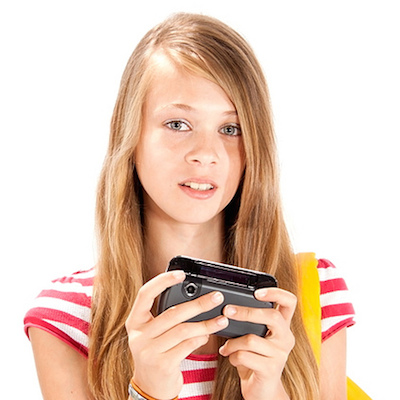

The American Academy of Pediatrics calls cyberbullying the “most common online risk for all teens.” Parents need to know the facts about cyberbullying.
Cyberbullying is deliberately using digital media to communicate false, embarrassing, or hostile information about or to another person.
Types of Bullying Online
According to the Internet Safety 101 curriculum, there are many types of cyberbullying:
- Gossip: Posting or sending cruel gossip to damage a person’s reputation and relationships with friends, family, and acquaintances.
- Exclusion: Deliberately excluding someone from an online group.
- Impersonation: Breaking into someone’s e-mail or other online account and sending messages that will cause embarrassment or damage to the person’s reputation and affect his or her relationship with others.
- Harassment: Repeatedly posting or sending offensive, rude, and insulting messages.
- Cyberstalking: Posting or sending unwanted or intimidating messages, which may include threats.
- Flaming: Online fights where scornful and offensive messages are posted on websites, forums, or blogs.
- Outing and Trickery: Tricking someone into revealing secrets or embarrassing information, which is then shared online.
- Cyberthreats: Remarks on the Internet threatening or implying violent behavior, displaying suicidal tendencies.
Facts About Cyberbullying
- 32% of online teens say they have been targets of a range of annoying or potentially menacing online activities. 15% of teens overall say someone has forwarded or posted a private message they’ve written, 13% say someone has spread a rumor about them online, 13% say someone has sent them a threatening or aggressive message, and 6% say someone has posted embarrassing pictures of them online.
- 38% of online girls report being bullied, compared with 26% of online boys. In particular, 41% of older girls (15-17) report being bullied—more than any other age or gender group.
- 39% of social network users have been cyberbullied in some way, compared with 22% of online teens who do not use social networks.
- 20% of teens (12-17) say “people are mostly unkind” on online social networks. Younger teenage girls (12-13) are considerably more likely to say this. One in three (33%) younger teen girls who use social media say that people their age are “mostly unkind” to one another on social network sites.
- 15% of teens on social networks have experienced someone being mean or cruel to them on a social network site. There are no statistically significant differences by age, gender, race, socioeconomic status, or any other demographic characteristic.
- 13% of teens who use social media (12-17) say they have had an experience on a social network that made them feel nervous about going to school the next day. This is more common among younger teens (20%) than older teens (11%).
- 88% of social media-using teens say they have seen someone be mean or cruel to another person on a social network site. 12% of these say they witness this kind of behavior “frequently.”
- When teens see others being mean or cruel on social networks, frequently 55% see other people just ignoring what is going on, 27% see others defending the victim, 20% see others telling the offender to stop, and 19% see others join in on the harassment.
- 36% of teens who have witnessed others being cruel on social networks have looked to someone for advice about what to do.
- 67% of all teens say bullying and harassment happens more offline than online.
- 1 in 6 parents know their child has been bullied over social media. In over half of these cases, their child was a repeat victim. Over half of parents whose children have social media accounts are concerned about cyberbullying and more than three-quarters of parents have discussed the issue of online bullying with their children.
- 11% of middle school students were victims of cyberbullying in the past two months. Girls are more likely than boys to be victims or bully/victims.
- “Hyper-networking” teens (those who spend more than three hours per school day on online social networks) are 110% more likely to be a victim of cyberbullying, compared to those who don’t spend as much time on social networks.
Anti Bullying Campaigns and Programs
- The Great American NO BULL Challenge
- Internet Safety 101
- Olweus Bullying Prevention Program
- Stomp Out Bullying
- Delete Digital Drama
Effects of Bullying
“While bullying through physical intimidation has long been a problem among teenagers, cyberbullying by using computers and smart phones to send rumors or post cruel messages has become more prevalent in recent years,” explains Dr. Jennifer Caudle. “Even though there might not be physical injuries, cyberbullying leaves deep emotional scars on the victim.”
Warning signs of being cyberbullied can include:
- appearing sad, moody, or anxious
- avoiding school
- withdrawing from social activities
- experiencing a drop in grades
- appearing upset after using the computer
- appearing upset after viewing a text message
In extreme cases, physical bullying and online bullying can drive a child or teen to deep depression and even suicide (sometimes called “bullycide”). Since 1983, over 150 children have taken their own lives due, in part, to the extreme pressure of being bullied.
When it comes to suicides related to cyberbullying, some names have made national headlines in recent years. Ryan Halligan (2003) may be the earliest known case of suicide provoked by Internet taunts, but unfortunately many others have followed: Jeffrey Johnston (2005), Kristina Calco (2006), Rachael Neblett (2006), Megan Meier (2006), Jesse Logan (2008), Alexa Berman (2008), Michael Joseph Berry (2008), Iain Steele (2009), Hope Wittsell (2009), Tyler Clementi (2010), Ashley Rogers (2010), Alexis Skye Pilkington (2010), Phoebe Prince (2010), and Amanda Cummings (2011).
Cyberbullying Videos
- The documentary, Submit* – the virtual reality of cyberbullying
- CBS’s 48 Hours special presentation, Bullying: Words Can Kill
- PBS’s Frontline report, Growing Up Online
- A clip from Enough is Enough, Cyberbullying 101
- Security Spotlight’s Cyberbullying Safety




Dear Luke Gilkerson,
My name is mady, and I’ve been trying to end my life for years now. I was and still am sexually harassed and even sexually assaulted. I trusted a boy enough to send nudes to him, and eventually, they were passed around the school. Everyone was laughing at me calling me names. That’s when the thoughts poured in. I hated myself. My dad wasn’t a big help to that either. He is always telling me that in a whore and slut, that is not worth his time. So I’ve found no reason to live. I wanted to contact you so you can use my story to help others.
-mady
Hi, Mady – Luke no longer works at CE, but I’m deeply concerned about your comments about suicide – here’s the truth…you have unmeasurable value! Don’t listen to the bullies or in this case, the words from your father. Your life is a precious gift and a blessing to this planet. Unique. Unrepeatable. Please find someone you can talk to about your struggles. If you don’t have anyone you can talk to, and you start to have suicidal feelings again, promise me you’ll call this number: 1-800-273-8255, if you are in the United States. They also have a chat feature that always has someone there to respond.
I’m for you and want you to live.
Chris
Mady love, I hope you see this. I will talk to you. I am 55 year old ( A cool one I have been told ;) ) grandmother :) .. I don’t judge and I listen. I want you around for years to come and I tell you why. In my mind’s eye after I read your letter, I could see you.. in a nice career… a couple of children after you are 30 (please wait til then :) ) and happy. Darling.. people are a**holes and there are so many out there that bully that do it because they them selves are miserable. They just want others to feel as bad as they do… it’s like they get off on it.Sweetheart, we all make mistakes.. some bigger than others, and it’s ok. No one is perfect and those little crappy highschoolers are just being jerks. I bet they have so many skele’s in their closet that they would just crawl back under their rock if something came up about them that wasn’t so ‘sweet or nice’. Don’t do anything crazy please. There ARE people that care, even tho you may think there isn’t.People DO care, even if it’s not a family member…. like me :) You just need to reach out, like you have here. So now there are 2 people here ready and willing to hear you and maybe even give you some great advice on what ever problems you are dealing with ♥ You my dear are worth more than any money or anything .. I hope in time you will see this. You are cared about by even me and Chris ( the young man who also wrote you ) and we don’ tknow you , yet. You don’t have to give your personal info out to either one of us. We only want to let you talk and get all this off your mind and out of your heart. You are the future <3 and we care. I know I want this world to be a better place and you would be one of those wonderful people that can and will make this world a better and nicer place. Please give life a chance. I think after the rough and bumpy road of highschool you will see that it was just that, a bump in the road and you are stronger than you think. I believe in you ^ ^
I didn’t realize how close to us bullies were until recently! My son was about to be bullied and he actually treated the situation is such a mature way, that he didn’t face any problems with the bully. Of course, my little boy was lucky enough to know better and he didn’t have to deal with a persistant bully. However, this is a serious issue that needs more attention, we all need to be aware of such an important problem of our society!
lol
i dont like bullies.
thats awesome